The Fisher Stevens-directed doc gives us a look behind the race to the 2017/2018 Formula E championship.
from CNET https://ift.tt/2ZPaxVj
Friday, 29 May 2020

Everything we know about Samsung Money video - CNET
Samsung is launching a new debit card and cash management account later this summer in the US. Here's what we know so far about Samsung Money by SoFi and how it will work with Samsung Pay.
from CNET https://ift.tt/36KzwKI
from CNET https://ift.tt/36KzwKI
Facebook employees reportedly criticize stance on not fact-checking Trump's posts - CNET
It follows the president signing an executive order after Twitter labeled and hid tweets it deemed as potentially misleading and glorifying violence.
from CNET https://ift.tt/3gxdMXo
from CNET https://ift.tt/3gxdMXo
Is there a rent freeze in June? Can landlords evict tenants? Late fees, laws and what to do - CNET
Learn about your current rights and find resources for financial relief if you're concerned about being able to pay your rent this month or in the future.
from CNET https://ift.tt/3eyn0B2
from CNET https://ift.tt/3eyn0B2
Russian agents have been hacking major email program
The US National Security Agency (NSA) has issued a cybersecurity advisory warning that the Russian military hacking group responsible for interfering in the 2016 presidential election has been exploiting a critical vulnerability in Exim since last August or earlier.
For those unfamiliar with Exim, the software is a mail transfer agent (MTA) that runs in the background of email servers. The software is currently the most popular MTA and a big reason for this is due to the fact that it is bundled with many popular Linux distros including Debian and Red Hat.
The timing of the NSA's advisory is a bit strange though as the critical vulnerability in Exim was identified 11 months ago and a patch has already been released to fix the issue.
- World's biggest email server hit with security flaw
- Hackers turn supercomputers into cryptocurrency mining rigs
- Also check out our roundup of the best email service providers
According to the president of Rendition Infosec and former US government hacker, Jake Williams who spoke with the Associated Press, Exim is so widely used that some companies and government agencies that run the software may have not yet patched the vulnerability. He believes that the NSA may have issued its new advisory to bring attention to the Russian military group known as Sandworm which has exploited the critical vulnerability in Exim in its attacks.
Sandworm
In its advisory, the NSA provided further details on the vulnerability in Exim that Sandworm is actively exploiting, saying:
“The vulnerability being exploited, CVE-2019-10149, allows a remote attacker to execute commands and code of their choosing. The Russian actors, part of the General Staff Main Intelligence Directorate’s (GRU) Main Center for Special Technologies (GTsST), have used this exploit to add privileged users, disable network security settings, execute additional scripts for further network exploitation; pretty much any attacker’s dream access – as long as that network is using an unpatched version of Exim MTA.”
While the NSA did not reveal who the Russian military hackers have targeted, in recent months senior US intelligence officials have warned that Kremlin agents are currently engaged in activities online that could threaten the integrity of the country's 2020 presidential election.
Organizations and government agencies that use Exim should apply this patch immediately if they have not already done so to avoid falling victim to any potential attacks.
- Keep your devices protected with the best antivirus software
Via MSN
from TechRadar - All the latest technology news https://ift.tt/36KFbjX
Toyota’s first plug-in hybrid RAV4 Prime priced a skosh under $40,000
When Toyota unveiled the 2021 Toyota RAV4 Prime in November, the vehicle garnered a lot of attention because it achieved two seemingly conflicting goals. It was Toyota’s most fuel efficient and one of its most powerful vehicles.
Now, it’s getting praise for managing a base price under $40,000. Toyota said Friday that the standard trim of the plug-in vehicle, the RAV4 Prime SE, will start at $39,220, a price that includes the mandatory $1,120 destination charge.
This plug-in RAV4 will have an all-wheel drive, sport-tuned suspension. When in pure EV mode it has a manufacturer-estimated 42 miles of range — putting it ahead of other plug-in SUVs. Toyota said it has a also has up to a manufacturer-estimated 94 combined miles per gallon equivalent. We’re still waiting on official EPA estimates.
The vehicle has a tuned 2.5-liter, four-cylinder gasoline engine and when combined with the electric motors will deliver 302 horsepower and be able to travel from 0 to 60 miles per hour in a projected 5.8 seconds.
The plug-in RAV4 will be offered in two variants. Toyota equips all of its RAV4 models with its standard active safety systems that includes a pre-collision system with pedestrian detection, full-speed range dynamic radar cruise control, lane departure alert with steering assist, automatic high beams, lane tracing assist and road sign assist.
The cheaper SE comes standard with some notable features like 18-inch painted and machined alloy wheels, heated front seats, a power liftgate, a 3-kilowatt onboard charger and a 8-inch touchscreen along with Amazon Alexa integration and Android Auto and Apple CarPlay compatibility. Some advanced driver assistance features such as blind spot monitor with rear cross traffic alert also comes standard.
There is a weather and moonroof package for an additional $1,665 upgrade, that adds extras like a heated steering wheel, heated rear outboard seats and rain-sensing windshield wipers with de-icer function.
The pricier XSE trim starts at $42,545 (with the destination price included) and offers more luxury touches such as a two-tone exterior paint scheme pairing a black roof with select colors, 19-inch two-tone alloy wheels, paddle shifters, wireless phone charger and a 9-inch touchscreen. There are several other upgrades, of course, including one for the multimedia system that adds dynamic navigation and a JBL speaker system. The daddy of upgrades on the XSE costs $5,760 and covers weather, audio and premium features including a heads-up display, panoramic moonroof, digital rearview mirror, surround-view cameras and four-door keyless entry.
The vehicle is expected to show up at dealerships this summer.


from TechCrunch https://ift.tt/3ewyHId
Zuckerberg explains why Facebook won’t take action on Trump’s recent posts
In a statement posted to Facebook late Friday afternoon, Mark Zuckerberg offered up an explanation of why his company did not contextualize or remove posts from the accounts associated with President Donald Trump that appeared to incite violence against American citizens.
“We looked very closely at the post that discussed the protests in Minnesota to evaluate whether it violated our policies,” Zuckerberg wrote. “Our policy around incitement of violence allows discussion around state use of force, although I think today’s situation raises important questions about what potential limits of that discussion should be.”
Facebook’s position stands in sharp contrast to recent decisions made by Twitter, with the approval of its chief executive, Jack Dorsey, to screen a tweet from the President on Thursday night using a “public interest notice” that indicated the tweet violated its rules glorifying violence. The public interest notice replaces the substance of what Trump wrote, meaning a user has to actively click through to view the offending tweet.
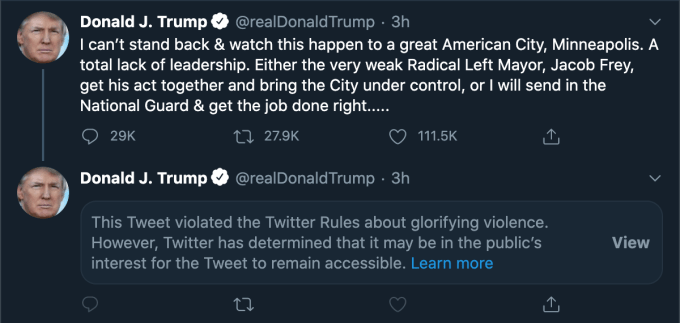
Critics excoriated Facebook and its CEO for its decision to take a hands off approach to the dissemination of misinformation and potential incitements to violence published by accounts associated with the President and the White House. Some of the criticism has even come from among the company’s employees.
“I have to say I am finding the contortions we have to go through incredibly hard to stomach,” one employee, quoted by The Verge, wrote in a comment on Facebook’s internal message board. “All this points to a very high risk of a violent escalation and civil unrest in November and if we fail the test case here, history will not judge us kindly.”
Zuckerberg defended Facebook’s position saying that it would not take any action on the posts from the President because “we think people need to know if the government is planning to deploy force.”
Facebook’s chief executive also drew a sharp contrast between Facebook’s response to the controversy and that of Twitter, which has provided a fact check for one of the President’s tweets and hidden Thursday’s tweet behind a warning label for violating its policies on violence.
“Unlike Twitter, we do not have a policy of putting a warning in front of posts that may incite violence because we believe that if a post incites violence, it should be removed regardless of whether it is newsworthy, even if it comes from a politician,” wrote Zuckerberg.
Twitter explained its decision in a statement. “This Tweet violates our policies regarding the glorification of violence based on the historical context of the last line, its connection to violence, and the risk it could inspire similar actions today,” the company said.
Twitter Comms
@TwitterComms
We have placed a public interest notice on this Tweet from @realdonaldtrump. https://twitter.com/realDonaldTrump/status/1266231100780744704 …
Donald J. Trump
Replying to @realDonaldTrump….These THUGS are dishonoring the memory of George Floyd, and I won’t let that happen. Just spoke to Governor Tim Walz and told him that the Military is with him all the way. Any difficulty and we will assume control but, when the looting starts, the shooting starts. Thank you!

“We’ve taken action in the interest of preventing others from being inspired to commit violent acts, but have kept the Tweet on Twitter because it is important that the public still be able to see the Tweet given its relevance to ongoing matters of public importance,” the Twitter statement continued.
Perhaps, as Zuckerberg suggests, Facebook will have an opportunity to provide some answers to the questions around what the limits should be around allowing the state discussion of incitements to violence. For now, the company’s response only begs more questions.
A link to the full post from Zuckerberg follows below:


from TechCrunch https://ift.tt/2BaywUx
Subscribe to:
Posts (Atom)